2026
Kurt Beers | Director, Beers Gallery, London (GB)
Spending time moving between Dominik Schmitts paintings and the accompanying writing, it becomes immediately apparent that Schmitt is not simply making paintings about ideas. Rather, he is constructing visual systems through which ideas are explored and tested. His practice has reached a level where technical confidence and conceptual ambition work together naturally.
One of the strongest qualities of Schmitt's work is its visual intelligence. The paintings function like psychological maps assembled from fragments of anatomy, natural history, philosophy, scientific illustration, popular culture and personal symbolism. Rather than presenting these references as quotations, Schmitt absorbs them into a visual language that feels entirely his own. The layered compositions continually shift beneath the viewer's gaze. Faces dissolve into diagrams, animals become metaphors, organs carry emotional as well as physical meaning, and almost every element seems capable of several readings.
Particularly admirable is the balance Schmitt achieves between order and instability. Although the paintings are densely constructed, they never feel chaotic. His understanding of composition, rhythm and scale gives each work a clear internal structure. There is always a path for the eye to follow, even when the narrative itself remains deliberately unresolved.
His technical ability is equally impressive. The highly rendered anatomical passages sit comfortably alongside looser painted areas, collage, drawing and handwritten text. The movement between illusion and construction reinforces the ideas at the centre of his practice. The paintings constantly remind us that perception itself is something assembled rather than fixed, and the physical process of collage becomes a convincing metaphor for the way knowledge, memory and belief are formed.
His use of colour also deserves recognition. The restrained greys and blacks establish a sense of anatomical precision, while the unexpected violets, pale pinks, mint greens and acidic yellows stop the work from becoming overly sombre. These moments of colour introduce humour, uncertainty and psychological tension. They invite the viewer in before revealing the greater complexity beneath the surface.
The recurring hybrid figures are particularly successful because they avoid becoming merely surreal. They suggest identities that are continually being assembled from biological impulses, cultural expectations and lived experience. This gives the work genuine conceptual depth. The viewer is never asked to solve a puzzle. Instead, they are invited to sit with uncertainty.
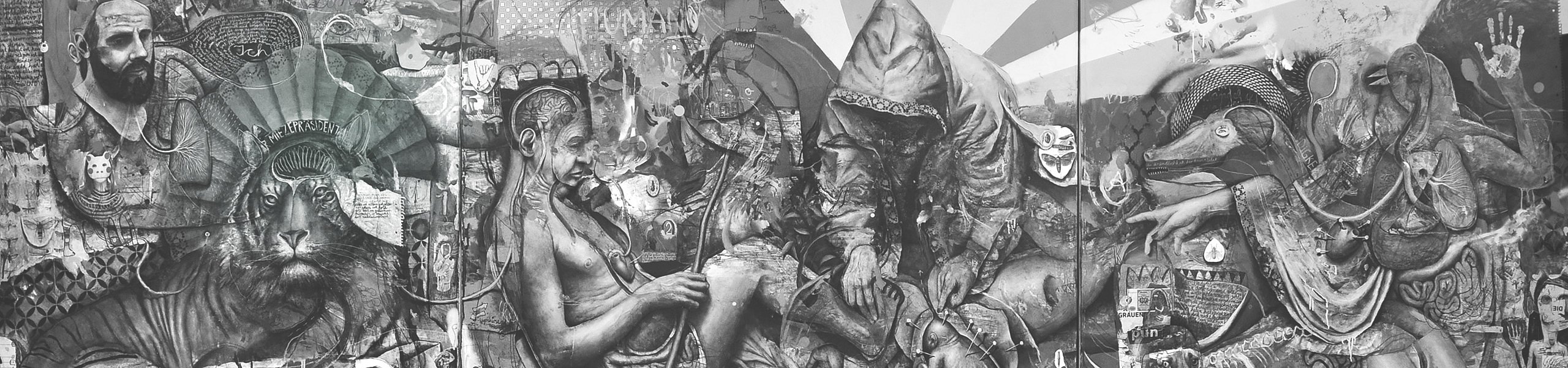
Particularly compelling is the large diptych "ufo, affe. tod" from 2026 featuring the primate and hooded figure. It demonstrates Schmitt's ability to hold multiple narratives together without losing compositional clarity. The relationships between evolution, technology, ritual and nature remain open rather than fixed, allowing the viewer to arrive at their own conclusions. Likewise, the fragmented portrait with its anatomical references is an exceptionally confident composition. The face appears to emerge and dissolve at the same time, reflecting the instability of identity that runs throughout his practice.
Schmitt's visual language has become so rich that many of the paintings operate at a consistently high level of density. There is an extraordinary amount for the viewer to absorb in every work. While this demonstrates remarkable inventiveness, introducing greater moments of restraint might occasionally strengthen the impact. Allowing certain paintings a little more breathing space could make the most significant forms and ideas resonate even more powerfully.
Similarly, some of Schmitt's recurring motifs have become recognisable signatures within the work. Anatomical organs, numbered fragments, connective lines, hybrid creatures and layered collage now form part of his established vocabulary. The conceptual framework is already extremely strong.
Schmitt's career reflects an artist who has built a substantial and consistent exhibition history across Germany, Austria, Switzerland and the United States, with gallery representation, museum exhibitions and participation in respected international fairs including Volta, Art Miami, Scope and Art Karlsruhe. That trajectory speaks to sustained development rather than isolated success, and it suggests that his work continues to find an audience in very different contexts.
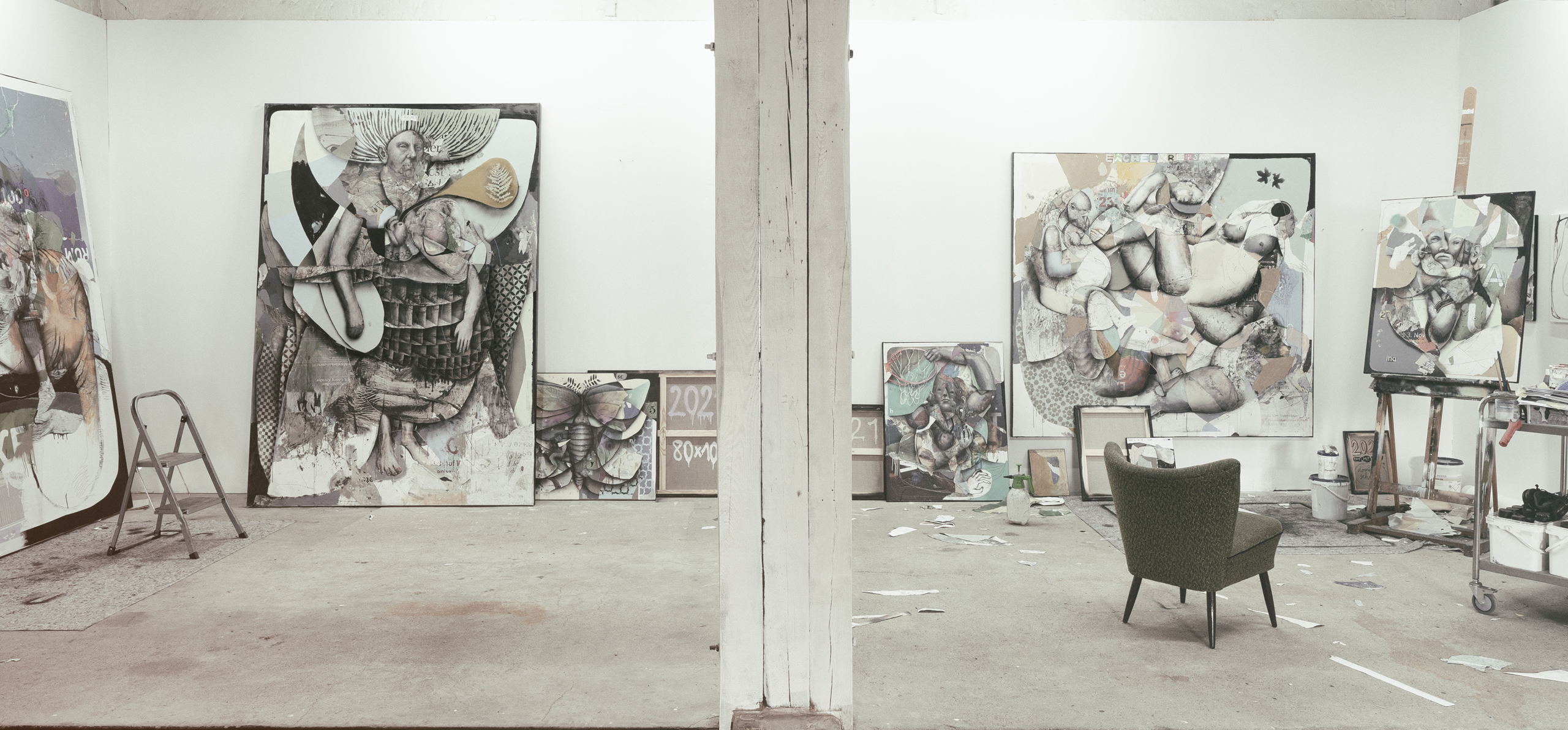
His paintings have a remarkable physical presence that is difficult to convey in reproduction alone. The layering, the torn edges and the shifts in surface deserve careful detail photography alongside clean installation images that communicate their scale and materiality.
Overall, Dominik Schmitt's practice occupies a compelling position between figurative painting, collage and conceptual art. It demonstrates technical skill without becoming an exercise in virtuosity, and intellectual ambition without losing its visual appeal. Most importantly, the paintings remain engaging before the viewer has begun to unpack their ideas. That is a balance very few artists achieve consistently.
The questions Schmitt is asking about belief, identity and perception feel especially relevant today, but the work avoids becoming tied to a particular political moment. Instead, it addresses the structures through which people construct meaning, making it likely to retain its relevance over time.
2026
Dr. Lil Helle Thomas | Deputy Director, Kunstmuseum Karlsruhe (DE)
Mischung, Vielfalt sowie Überfluss und Überforderung – die Zugänglichkeit von Informationen und deren Konsum ist heute zugleich Privileg wie auch Herausforderung. Der Begriff des postfaktischen Zeitalters, der uns seit über zehn Jahren im politischen Diskurs begleitet, treibt Dominik Schmitt in seinen Bildwelten um. „Überprüfbare Fakten“ ist ein feststehendes Begriffspaar, das in unserem alltäglichen Sprachgebrauch einerseits selbstverständlich geworden ist und in der praktischen Umsetzung doch fortwährend hinterfragt und von allerlei Spekulationen überlagert wird. Man bedenke nur, dass der Begriff der „Fake News“ nicht weniger geläufig ist.
Diesem Oszillieren zwischen Wissen und Glauben widmet sich Dominik Schmitts künstlerische Arbeit. Seine sowohl figurativen als auch ornamentalen Darstellungen arbeiten mit dem Fragment und erheben die Auffaltung und immer kleinteiligere Segmentierung von gesellschaftlichen Diskursen zu ihrem eigentlichen Thema. Was ist gemeint? Eine Betrachtung der Arbeit „zwischenzeit“ verdeutlicht dies: Dominik Schmitt betont, dass seine Werke uns Betrachterinnen und Betrachter gerne mit Fragezeichen konfrontieren, und dieses monumentale Bild ist hierfür exemplarisch. Wird es doch – ähnlich einem Altaraufsatz – mit dem Sinnspruch gekrönt „CHAOS REGIERT“. Zwei Weltsichten lässt Schmitt hier von links und rechts aufeinanderprallen, während ein Mischwesen aus menschlichen und tierischen Körperteilen – ähnlich dem hinduistischen Gott Vishnu – im Zentrum der Darstellung alle Hände voll zu tun hat, eine einigermaßen plausible Ordnung herzustellen – beziehungsweise vielleicht bereits an diesem Vorhaben gescheitert ist. Immerhin erfüllt Vishnu im Hinduismus die Rolle des „Bewahrers einer kosmischen Ordnung“. Neben den Konterfeis bekannter Politikerinnen und Politiker und Journalistinnen und Journalisten finden sich bei längerer Betrachtung dieses Tohuwabohus auch Personifikationen, erkennbar an ihren Beigaben wie für Justitia die Waagschale, wie für unterschiedliche Zukunftskonzepte politischer Parteien eine Gießkanne und ein Benzinzapfhahn. Als Symbole unserer Zeit können wir die Botschaft dieser Attribute leicht entschlüsseln. „zwischenzeit“ hatte einen durchschlagenden Erfolg bei der art Karlsruhe 2024, und dennoch erfährt die Arbeit über das Detail des Benzinzapfhahnes mit seinen weltökonomischen Abhängigkeiten aktuell nochmals an Brisanz. […] Glaubenskriege, politische Machtdemonstrationen und ökonomische Abhängigkeiten verstricken sich zu einem unüberschaubaren Wirrwarr. Unterlegt ist bei „zwischenzeit“ die illustre wie auch apokalyptische Gesellschaft von der deutschen Nationalflagge, gemusterten Fliesen und Blätterzweigen. Sie sind darüber hinaus über Wurzeln und andere biologische Leitungssysteme physisch miteinander verbunden, ja miteinander verwachsen. Zuweilen legen die Protagonistinnen und Protagonisten – ähnlich medizinischer Anatomielehrtafeln – ihr Körperinneres dar und zeigen uns Lungen, Magen oder das Gedärm. Wenn man weiß, dass Dominik Schmitt Kunst und Biologie auf Lehramt studiert hat, wird spätestens klar, dass er ein Vertreter engagierter, politischer Kunst ist. Schmitt führt uns eine Bildwelt nach der Moderne vor Augen. Die Moderne war von Vernunft angeleitet und strebte nach Fortschritt. In ihr wurden geltende Wahrheiten formuliert, und funktionale Klarheit wurde als Credo propagiert. Hier hingegen können wir in vielen der Arbeiten bemerken, dass wissenschaftliche Ordnungssysteme ins Leere laufen. Beispielsweise finden sich in vielen seiner Arbeiten Zahlen und Buchstaben verteilt, die – ähnlich biologischer Bestimmungstafeln – als Verweise auf eine erklärende Legende gelesen werden könnten. Doch die erklärende Legende bleibt eine Leerstelle.
[…] Zugleich sind es auch die bereits erwähnten Fragezeichen, die für eine individuelle Auseinandersetzung mit seiner Kunst plädieren. In einem Telefonat im Vorfeld der Ausstellung bemerkte der Künstler, dass es für ihn einen Glücksfall darstellt, wenn wir uns von seinen Arbeiten im besten Sinne provoziert fühlen und uns infolgedessen zu einer Beschäftigung mit seinen Bildwelten einlassen. Dabei verwies er auf ein Detail des Textfragments „CHAOS REGIERT“. Es handelt sich um eine Variante einer Aussage des Künstlers Jonathan Meese, die lautet: „Die Ordnung, die ich brauche, ist das Chaos.“ Kunst folgt ihrer ganz eigenen Logik und kann unsere Aufmerksamkeit gefangen nehmen – eine Form des Mischkonsums.
2024
Gabe Torres | Curator, The CAMP Gallery, Miami (USA)
Dominik Schmitt creates pictures that are idiosyncratic in the best sense of the word, that catch the eye, that linger in the memory. Pictures that the viewer cannot possibly grasp at first glance due to their complexity and richness of detail. Should he nonetheless try to do so, he will be easily deceived. First of all, there is the dark coloration with a rich spectrum of broken black, gray, and earth tones, resulting in an unsettling and slightly melancholic basic mood. In terms of motifs, Schmitt’s paintings confront us with glimpses into the inner workings of human and animal life. Although the figurative dominates, the creatures in Schmitt’s pictorial world are always highly idiosyncratic beings from an in between realm, located beyond reality. Again and again we encounter amalgams of human and animal, often with limbs deformed or out of proportion. They sometimes seem to almost jump out of the picture – possessing a terrible beauty and fascination in their uniqueness, in their otherness. One might feel a bit transported to the world of figures found on the capitals and among the gargoyles of Romanesque and Gothic churches, or in the depictions of hell of a Hieronymus Bosch or Pieter Breughel – a playful approach to the unfathomable and the frightening.
The uniquely human advantage that we have gained over the course of evolution is perception of a future yet to come; that we can have a hope for the possibility of a future that has yet to arrive. In that we grow as an individual, and by extension as a society. That understanding of a future leads us to make changes to our routines and our own persona, and in the case of Dominik Schmitt, the very essence of his art. From Darkness Comes Color is an exploration of Schmitt’s past, present and future in terms of the evolution of not only his visual aesthetic but the entire process and thematics of his artwork. The artistic process is an endless journey, where slight adjustments that could be made in line, texture, and color if not transplanted to the canvas become encircling thoughts in the mind of the artist. Dominik, by his nature as a painter, toils away at canvases layer upon layer, each exposed just enough to see the thoughts that led to each subsequent coat. It is a perpetual series of thinking of the next step, the next element that adds to the piece over hours, days and months. The aforementioned element of future perception given to us allows for this development in piece by piece to exist, and Schmitt’s work has adapted the concept to his entire repertoire. The encompassing darkness of Schmitt’s pre-2020 work is noticeable, from desaturated hues to the chiaroscuro-dominating atmosphere of the figures. One can easily call this Schmitt’s “Dark Era”, but the figures and tone inched closer to the studies of realism of one invested into the studies of the historical arts. Upon reaching the quarantine of the world however, the semblance of a new era begins amongst Schmitt’s style and themes. The emergence of large pastels, the rounded geometrics shapes, and the reactionary pieces to modern events as opposed to the memory vaults that thematically defined his work before have transformed Schmitt’s catalog. Now unafraid of seeking a new future in his art, there is more of the artist than ever before in the emotions that the artist is portraying. All of this is due in part to the restrictions placed upon the world at the time leaving time for introspection within a secluded dwelling. And the future that Dominik vividly saw after lockdown was released was clearly one in which he was no longer under restraint.
His newest works, unconstrained even by medium as they pass unto paper form, release a barrage of colors and surrealism unlike the times of the past. In works such as "nur ein fogel fon fielen" (2023) and "Holding a stick - Being Happy" (2023), they have met the full saturation of their colors, to the point where even the white space has become an integral part of the piece. The surreal figures, still homaging their chiaroscuro roots, have undergone vast changes in proportion and playful crudeness. The serious and studious versions of his work prior have now made way for a child-like exploration where everything is new in the worlds of his work, where beast and man are one in the same. The realized future of Dominik’s style has expanded into this newest suite of works and grows even now in his inspiration for the next generation of pieces he inches away from now. “No one knows what the future may hold”, as cliche a phrase as it is, is a blessing in itself, as the concept leaves us to make our own decisions into what that future may be. The human instinct to want more of ourselves, to grow and nurture both our own intrinsic needs and that of a newer generation is part of the reason we have advanced as far as we have while having so little time on this planet. Dominik’s work is constantly in that pursuit, constantly affecting himself now and every path that his work heads in, fluxing and flowing at every point in time it has been and will be. It is a progression that from start to finish will be much akin to his own work, a gradient that at the end will burst forth in imagination like colors galore.
2021
Dr. Kristina Hoge | Art Historian, Gallery Director, Heidelberg (DE)
(Translated by Neil Solomon)
Every young artist today faces great challenges in view of the past centuries of art and art history and the overwhelming diversity and possibilities found on the art market. How can I find my own way in this “jungle,” assert myself as an artist, and develop a characteristic and recognizable “handwriting”? Dominik Schmitt has undoubtedly succeeded in this. He creates pictures that are idiosyncratic in the best sense of the word, that catch the eye, that linger in the memory. Pictures that the viewer cannot possibly grasp at first glance due to their complexity and richness of detail. Should he nonetheless try to do so, he will be easily deceived. First of all, there is the dark coloration with a rich spectrum of broken black, gray, and earth tones, resulting in an unsettling and slightly melancholic basic mood. In terms of motifs, Schmitt's paintings confront us with glimpses into the inner workings of human and animal life. Although the figurative dominates, the creatures in Schmitt's pictorial world are always highly idiosyncratic beings from an in-between realm, located beyond reality. Again and again we encounter amalgams of human and animal, often with limbs deformed or out of proportion. They sometimes seem to almost jump out of the picture – possessing a terrible beauty and fascination in their uniqueness, in their otherness. One might feel a bit transported to the world of figures found on the capitals and among the gargoyles of Romanesque and Gothic churches, or in the depictions of hell of a Hieronymus Bosch or Pieter Breughel – a playful approach to the unfathomable and the frightening. Hybrid creatures such as the Karlsruhe plate horse, the stiletto goose, the juice rabbit or the potato noodle dove are simply fantastically absurd and provide their very own answers to the question of what is beautiful or what is right. The written elements contained in the pictures – either in handwritten sequences or inserted fragmentarily as collage – and even the titles of the works themselves often contain ironic and witty inflections and puns. And they are always significant for the content and the perceived basic mood of the compositions. Thus, Schmitt always puts the viewer's perception and associative abilities to the test, and not only through the complexity of his pictorial elements. He also does so through the ambiguity or audacious deceitfulness of his titles – for example, when the work fat lion so clearly shows a tiger. Thus, the more intensively one examines the pictorial world of Dominik Schmitt, the less dark and gloomy it turns out to be. Instead, most of the works are full of astute and humorous allusions, making reference to art history, citing role models, reflecting on philosophical content, and unfolding their own unique poetry as they circle around what it means to be human – in a word, iconically ironic. It is not an art that is easy to consume, but rather an art that polarizes and would like to generate discussion by means of its content: for example, about religion, the course of the world, or the dissolution and blurring of the lines between humans and animals, inside and out, dream and reality. It is an art that does not just dwell on the surface, but penetrates deep, into inner strata, while at the same time incorporating technical sophistication and aesthetic qualities. The complexity of the works – which, at first glance, is easy to overlook – is also reflected in a characteristic and multi-layered working technique that Schmitt has developed for himself. In a first stage of work, paper is collaged on canvas and then provided with a layer of "muck" – consisting primarily of paste and other "additives." Only after this substrate is prepared does the actual pictorial arrangement follow on top of it. Especially in the current creative phase during the "corona pandemic," there is another quite relevant and exciting preparatory step that should be mentioned. Following as it were in the footsteps of the so-called affichistes of Nouveau Réalisme of the 1960s, the artist “collected” torn-off posters, such as of events that never took place. Initially, a destructive and disintegrative process is inherent in this technique of décollage, which is transformed into its opposite by the collage-like application to the canvas. The poster fragments become the actual medium of the image, and their titles or written sections often have a “say” in the finished work. Thus, seeing and collecting this information comes at the beginning of the pictures and represents a kind of “initial spark,” an impulse, from which the work then “flows,” developing directly and intuitively onto the canvas. Schmitt explains the inspiration for his special way of working, on the one hand, with his own aspiration to produce large pictures despite the more drawing-based character of his work, leading him to assemble many small details into a larger whole. On the other hand, he has long been fascinated by the floor of his studio, on which bits and pieces of past work are stuck and randomly combine to unfold their very own beauty. The specific strata-based working method results in layerings on the canvas, which sometimes take on an almost haptic quality. Due to the torn and collaged poster fragments, the works often exude a slightly nostalgic flair, conjuring up the charm of crumbling house walls or fading plaster, just as the layers of posters remind us of the transience and ephemeral nature of the flood of information, events, and advertising. Progressive traces of color or grainy, coarse sections in which the background comes to the fore alternate with details finely executed to deceive the eye. Graphic elements appear next to or in monochrome areas of color, which, especially in more recent works, impart an increasingly airy quality to the overall composition. The current work sleeping cyclist provides a particularly vivid example of this. Here, large areas right in the picture's foreground are simply left as colored surfaces and are set – tension-laden and with a circular movement – against a dense center. Old master perfection is broken up by street-like presence. The always figurative orientation of the pictures is nevertheless also defined by arabesque line bundles, pattern fragments, or freely drawn abbreviations. Light and dark, beautiful and repulsive, black-and-white restraint and colorful accents, all these contrasting pairs give Schmitt's works their characteristically tension-laden overall structure. The gathering together of all the individual elements and fragments contained in the works always appeals to the cognitive and visual abilities of the viewer, arousing their curiosity to put the pieces of the puzzle together and thus keeping the works from ever getting boring. In Schmitt's work in general, there is a preference for playing with layering, to superimposing one element upon another. When asked about this, the artist refers, in purely formal terms, to a relationship to Cubism, as well as to a decided interest in pointing out an "in front of" and a "behind." It is precisely these characteristically nested, layered structures that draw the viewer completely into the pictures and invite the eye to delve into deeper levels. A vivid example of this is provided by the noodle colander theorist, whose arms seem to pierce the picture's surface, just as, in contrast, the wings of the old moth create the visual impression of being fanned out in front of the picture's flat surface. In terms of technique, the artist commands an exceedingly rich variety. In addition to collage, drawing, and painting, we also encounter stencil and writing elements. Schmitt's work refuses to be categorized unambiguously, just as it refuses a one-sided stylistic classification. Elements evocative of the pictorial worlds of a Bosch or Breughel appear alongside stylistic borrowings from Cubism. Notions of Surrealism with its écriture automatique and tendency toward introversion are just as recognizable as elements of Street Art with its use of script, spray paint, and stencils. Authenticity is a very important factor for Schmitt, and so there is always something of himself in all his pictures. This can be quite literally the case, as exemplified by his frequent self-portraits, which are readily included, especially in the many-figure works. An impressive example of this is provided by the artist's largest canvas to date, at 2.50 by 4.80 meters, entitled causal canon. Here, it is not only that a self-portrait of the artist's head is hidden at the top left among the dense mesh of his typical pictorial elements. In addition, further down the canvas one can read: “Art needs content, art needs viewers who feel the art” – an avowal of one’s own creative work. The work noodle colander theorist can also be interpreted as a kind of “commentary” on one's own existence as an artist – the artist himself functions as a sieve through which things from the outside world, from the immediate surroundings, flow. He can either close himself off from these influences or open himself up to them, allowing them to pass through, filtered, as it were, through his own internal being. This is also what is said in picture 57 in the white-on-black handwritten text "I am a noodle sieve". The noodle strainer is undoubtedly part of the personal canon of recurring symbols that the attentive viewer can find in Schmitt's pictorial worlds. The fern leaf should also be mentioned here, a seemingly inconspicuous, frequently recurring element. It is the only plant that undergoes a so-called alternation of generations and is for this very reason of particular importance to the artist, as something that harbors a secret not apparent at first glance. Even if the artist himself is not included in the picture in the form of a self-portrait, his works always revolve around topics that concern him or have a close personal connection. Thus, aside from self-portraits, there are personal references, for example, to his Palatinate homeland – potato noodle dove – and to his own hobbies – air lambrecht – the artist plays basketball and has installed a basketball hoop in his spacious studio space. And then there are Schmitt's core topics, the subjects of his university studies, alongside of art: biology, education, religion, philosophy. Relevant topics about which the artist sometimes likes to be provocative, especially on questions of faith and religion. For example, in large-format paintings such as god question with a crucified human–animal being at its center that is clearly female, or adam and edam, in which biblical content is confronted with Darwin and the history of evolution. Art needs content – content that asks questions, but without prescribing answers or following well-worn paths. Here, we have someone who does not do what others want to see or what the market dictates, but stays within himself, doing his own thing, undeterred – and that is precisely what brings success.
2017
Prof. Dr. Christoph Zuschlag | Art Historian, University of Bonn (DE)
(Translated by Neil Solomon)
“Today the artist does not say: Come here and see flawless works of art, but rather: come and see honest works. And it is the effect of this honesty that makes these works appear as a protest, while the painter thought of nothing other than conveying his impression.” The person who wrote this was an important pioneer of artistic modernism: Édouard Manet. The French painter and graphic artist caused several (Salon) scandals because of his novel manner of painting and representation as well as his everyday motifs taken from modern big-city life. In 1867, during the World Exhibition in Paris, Manet showed a retrospective of his work in his own pavilion near the official exhibition building. In his catalogue foreword, a kind of artistic manifesto, Manet demands that the artist must be “honest” and strive solely to be “himself and no other.” With this he declares individualism to be the highest artistic value.
While walking through the exhibition Seeing Manet – The Gaze of Modernity at the Hamburg Kunsthalle, I think of the studio conversation I had the day before with Dominik Schmitt in Landau, which also revolved around the concept of honesty. Being an artist means, according to Schmitt, being authentic and honest, i.e., processing only what truly concerns him in pictorial form. And that is quite something!
Dominik Schmitt completed his studies in biology and art at the University of Koblenz-Landau, Campus Landau, with the First State Examination and a Master’s degree for teaching at grammar schools. In the arts he has not only emerged as a painter and draftsman, but also with film works, sculptures, installations, music, and poetry. For his young age, the list of exhibitions and awards is impressive.
During the studio talk, Dominik Schmitt used a term that seems to me more suitable than any other to characterize the essence of his art: introspection. This term is used in various academic disciplines, for example in psychology (in the sense of self-observation), in medicine (for insight into the interior of the body), or in linguistics (also in the sense of self-observation or of evaluating ambiguity according to one’s own perception). In his irritating, disturbing, sometimes even shocking pictorial worlds, Dominik Schmitt literally grants views into the interior of bodies. His art is based on an intense inward gaze, an engagement with himself, but also with his environment. Art is for Schmitt a medium and a form of communication between artist and viewer. His images contain messages, but are open and ambiguous insofar as every viewer can decode and interpret them according to his or her own perception.
Schmitt’s pictures are dominated by a dark, almost gloomy palette, although in recent times the palette has become somewhat brighter and also includes colorful areas in which the artist uses a squeegee, a tool originating from screen printing. Gloomy or melancholic are also the depicted scenes: the pictorial worlds are populated by animals, humans, and hybrid creatures of animal and human, whose bodies are often shown as if cut open, so that the viewer can look inside with a kind of X-ray gaze. At the same time, there is unmistakably also an ironic, witty side in the images that consciously quotes childlike-naïve modes of expression, although this only becomes apparent through intensive viewing. Another characteristic should be mentioned: the pictures are often densely filled with motifs up to the edges (“horror vacui” = fear of emptiness).
How does Dominik Schmitt proceed when painting his pictures on canvas? He does not have a precise plan of the finished image before he begins, but rather a vague basic idea, a sense of the feeling the picture should later convey. Consequently, there are no preliminary or underdrawings. Instead, the composition develops piece by piece during the creative process on the canvas, and this process is guided intuitively, not cognitively. The pictures are always mixed-media works on canvas. First the surface is completely covered with paper, using old used study materials and more recently new large sheets of paper. Then a layer of wallpaper paste is applied. Further processing is done with water and dark acrylic paints, producing a special rough, rugged structure that the artist likes. Oil paint, various pencils and chalks, and stenciled sprayed areas are added at later stages once the figures are fully laid out in acrylic. The figures emerge from the painterly structure, i.e., out of the process. Schmitt uses photographs from the internet or magazines, or his own photographs, but never copies them; instead he transforms them according to his ideas. Texts are then integrated, handwritten, stenciled, or as printed, collaged elements. The texts are often ironic and witty (for example one picture reads “All anger comes from within”), contain wordplay, or comments on the pictorial motifs.
In large-format multi-figure paintings he completes one figure after another, then adds symbols and text fragments to gradually shape the statement. During painting, deeper layers are partially scratched free, and not infrequently the canvas is turned during the process (which can be seen, for example, in color gradients). Dominik Schmitt always works on several paintings in parallel, often more than ten, with ideas, motifs, and figures sometimes “wandering” from one picture to another. Depending on format and number of works in progress, the artist works between one week and half a year on a piece. Only when a canvas is completely coated with liquid varnish, giving the images a glossy surface, is the picture finished. The titles usually arise only afterwards.
One of the first pictures in a truly monumental format was created in 2015 and bears the title kunsthalle mannheim, requiem. In it Schmitt addresses the architecture and history of the Kunsthalle Mannheim, where he worked for several years as a museum educator. Integrated into a view of the Art Nouveau building by Hermann Billing are portraits of the various architects involved, but also a childhood portrait of the artist and many other motifs. The most recent large-format work, mein begräbnis in landau (2016), quotes in title and composition Gustave Courbet’s famous painting A Burial at Ornans as well as El Greco’s painting The Burial of the Count of Orgaz. Teachers of the Art Institute in Landau, namely Günther Berlejung and the author of this text, lay Schmitt’s corpse in the grave. The reference to depictions of the Entombment of Christ is clear, underscored by the (colorful) halo around the artist’s head. Around the group stands a multitude of persons: portraits of family members (Schmitt’s brother holds his heart in his hands), friends, other teachers, collectors and gallerists, as well as artists whom Schmitt admires: El Greco, Gustave Courbet, Jonathan Meese. Allusions to Christian iconography, especially the Passion of Christ, are found repeatedly in Dominik Schmitt’s work, for example also in selbst (2015). Since the Renaissance there has been the topos of the divino artista, the godlike creative artist. In modern times another myth emerged, that of the artist as “exemplary sufferer” (Susan Sontag), as a martyr who is lonely and on his own.
Let us consider a few more pictures: picknick (2015) is a typical example of Dominik Schmitt’s consistently eminently ego-related, autobiographical art. The picture shows a group of four sad-looking figures in a semicircle. Here the artist processes his disappointment about rejected applications; the individual figures are largely taken from older paintings that Schmitt had unsuccessfully submitted to competitions. pförtner (2015) is the first in a new series of light-ground paintings. A male figure is penned into a kind of cow and controls it. The man has raised his right hand in a gesture of blessing; around his head one sees a kind of halo. As already mentioned, such Christian-religious allusions are found in many pictures, as are sexual allusions. The title pförtner is ambiguous, because “Pförtner” is also the German term for the sphincter muscle at the entrance to the stomach. This muscle opens when food is to pass from the esophagus into the stomach and then closes again immediately to prevent reflux (if this does not work, one gets heartburn).
A new element in Dominik Schmitt’s pictures is the use of wallpaper fragments from the 1960s or 1970s, which his teacher Günther Berlejung brought him. Such collaged wallpaper pieces appear in schaf (2016), küche (2016), and schweigeminute (2016). In the last two images the artist was interested in the illusion of a room in which the figures are arranged. The impression of spatial depth is reinforced by the painted black-and-white floor tiles, which, however, are not arranged in correct (central) perspective but appear folded into the picture plane.
In recent years Dominik Schmitt has developed an unmistakable individual style and a very own pictorial language in which representational motifs, symbols, and written signs enter into a unique symbiosis as different information media. He draws his inspirations less from observation of nature than from art history, especially the epochs of Gothic, Renaissance, and particularly the Baroque, but he also feels a strong affinity to contemporary artists such as Anselm Kiefer, Daniel Richter, and Jonathan Meese. His art, always committed to figuration, cannot be assigned to a conventional concept of style or school, although there are certain echoes of Fantastic Realism. Thus, in his pictorial worlds removed from time and space, the boundaries between reality and fiction dissolve. The beings that populate Schmitt’s pictorial worlds seem to belong to a fantastic, timeless place, a kind of in-between realm that also resonates in the title of this catalogue chosen by the artist: Nirgendwann, a coined word composed of nirgendwo (nowhere) and irgendwann (sometime).
Dominik Schmitt’s works reflect (often involving his own body) his personal states, moods, and feelings. “Each picture is basically a self-portrait, a psychogram of myself,” says the artist. With this he refers to the phenomenon known in recent art-historical research as automimesis, according to which an artist always unwittingly represents himself in his works. Whether Schmitt’s pictorial worlds appear comic, grotesque, childlike, ironic, creepy, or entirely different, lies solely in the eye of the beholder. The artist himself does not perceive his pictures as gloomy, nor does he want to shock the audience, but rather to guide them toward self-exploration. Ultimately, Dominik Schmitt’s pictures demand a great deal from the viewer, for they throw him back upon himself. From the artist’s introspection arises the introspection of the viewer.